
Accounting, Audit & Reporting
Financial Reporting Frameworks and NFRS Applicability in Nepal
Financial reporting requires more than choosing an accounting-software template. Nepal has full Nepal Financial Reporting Standards, NFRS for SMEs, Nepal Accounting Standards for Micro Entities and a framework for qualifying not-for-profit organisations. Entity type, public accountability, the applicable definitions, regulatory requirements and effective year determine the correct framework. Industry-registration descriptions and income-tax return categories do not automatically determine financial-reporting eligibility.
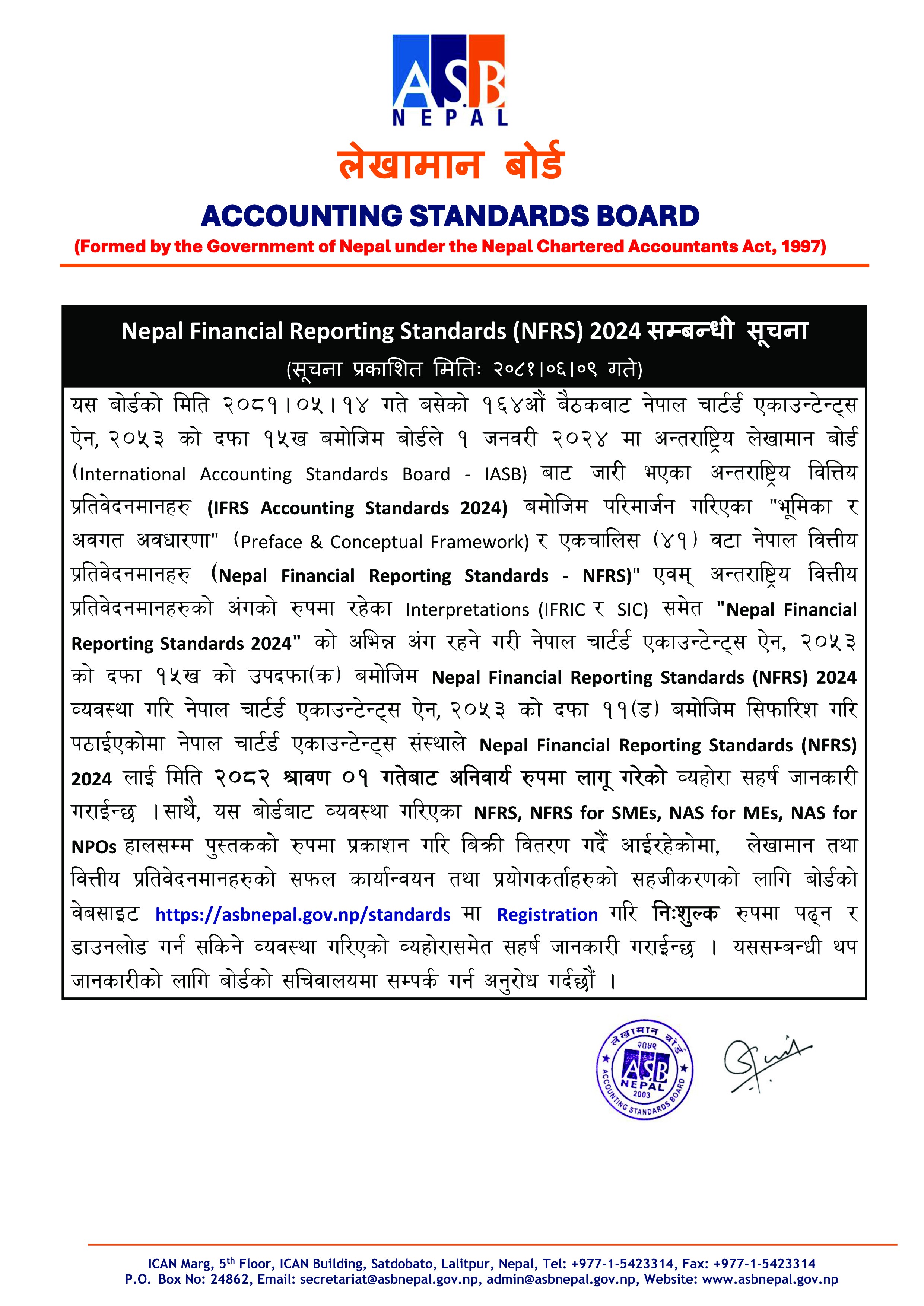
ASB's official NFRS 2024 adoption notice states that ICAN made NFRS 2024 mandatory from 1 Shrawan 2082. That statement concerns entities to which full NFRS applies; it does not make every small proprietor a full-NFRS entity. ASB also published an amendment to the micro-entity definition in its attached amendment notice. Use the current definition instead of copying older thresholds.
1. Framework selection file
| Question | Evidence | Effect on selection |
|---|---|---|
| Does the entity have public accountability? | Securities, fiduciary and relevant activity facts | May exclude SME or micro treatment |
| Is a sector regulator's rule applicable? | NRB, insurance, securities or other current instruction | May specify reporting requirements or permitted treatment |
| Does the entity meet the micro definition? | All current limits and consecutive-year history | Consider NAS for MEs when eligible |
| Does it meet the SME definition instead? | Current NFRS for SMEs scope and exclusions | Consider that separate framework |
| Is it a qualifying NPO? | Constitutional purpose and ASB definition | Assess NAS for NPOs applicability |
| What is the reporting period? | Year and effective/adoption notices | Select the correct edition and transition rules |
Keep the signed selection memo with the financial-statement file. Explain the facts and source provisions instead of merely stating “small company.” A prior-year audit report is useful history, but the entity may have crossed a threshold or become publicly accountable since then.
2. Nepal example
A manufacturing company with turnover of NPR 150 million, borrowings of NPR 70 million and gross balance-sheet total of NPR 180 million appears within three current micro limits. That alone does not complete the assessment. It must also satisfy the fiduciary-assets limit, public-accountability condition and the required consecutive-year test, and its regulator must not impose a conflicting framework. If these facts are confirmed, the preparer documents the framework conclusion rather than importing a full-NFRS statement set only because the software supplies one.
Conversely, a modestly sized entity with public accountability cannot rely solely on low turnover to select micro reporting. The accountability test comes before a numerical shortcut.
3. Applying a selected framework
Use the selected framework consistently for recognition, measurement, presentation and disclosure. Tax depreciation, tax deductibility and tax-return forms require a separate tax computation. A loan covenant's management report or donor budget may require additional schedules without replacing the statutory financial statements.
For a transition, identify the applicable first-time or change requirements, opening balances, comparative information and disclosure obligations. Prepare a standards-and-policy map covering the entity's material transactions. Review regulator-specific carve-outs and their effective periods individually. A permitted carve-out for one regulated population should not be applied to an unrelated company.
4. Current standards and draft material
ASB's public notices distinguish adopted reporting standards from exposure drafts, including sustainability and other consultation material. Label a draft as a draft. A training course or an international issue date does not establish a Nepal effective date.
Before signing, the preparer and reviewer should confirm the framework, edition, current amendments, regulator instructions and accounting-policy consistency. Retain the actual official notices used. This article explains selection and implementation; it does not reproduce copyrighted standards or certify an entity's eligibility without its facts.
5. Check economic significance as well as micro limits
ICAN's December 2025 implementation reference separates public accountability, including economic significance, from the micro-entity limits. Its economic-significance measures include borrowing of NPR 500 million or more, gross balance-sheet total of NPR 1,000 million or more, average employment above 300, turnover of NPR 1,000 million or more, and fiduciary assets above NPR 500 million. The reference specifies a two-consecutive-year test for attaining at least one limit and falling below all limits to cease that classification.
These reporting measures do not replace the other public-accountability conditions, sector requirements or the current micro-entity definition. A company can therefore be below a turnover limit while another relevant condition determines its framework. Document the complete assessment and any transition, then apply the chosen framework consistently to the statements and notes.
Official sources
- ASB NFRS 2024 adoption notice, issued 2081.06.09
- ASB — SME and micro-entity amendment notice, 2082/05/02
ASB amendment notice 2082.05.02 · One-page attachment, Introduction C/NFRS for SMEs 1.11
- ICAN — Effective dates of NFRS, NAS and NSA, December 2025
- ASB Notices
Official reference; see source-review scope · Not independently verified in every substantive provision
- ASB — NFRS 2024 adoption notice
Official reference; see source-review scope · Not independently verified in every substantive provision
- ASB — SME and micro-entity amendment notice, 2082/05/02
Official reference; see source-review scope · Not independently verified in every substantive provision
Before using this guide
Source review: 12 October 2026
The sources support the scope of this general guide. Before applying it, check the actual entity, transaction, reporting period and any later amendment.
Checks for your case
- Determine the entity’s actual public accountability, all framework criteria, sector instructions, policies and transition requirements.
Latest update
- 13 October 2026
Editor: C.M. & Associates
Updated the article presentation and navigation. The cited source-review dates and any transaction-specific limitations still apply.